Should I Get a Cortisone Injection if My Foot or Ankle Hurts?
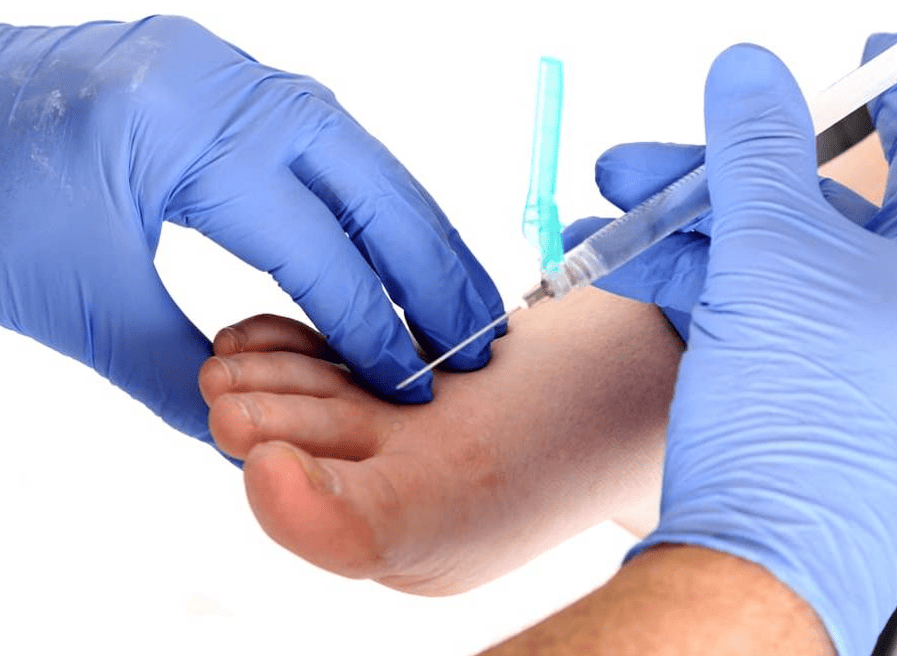
Patients with foot or ankle pain are frequently offered a cortisone injection. The appeal is understandable: the injection is quick, cortisone is a powerful anti-inflammatory medication, and in some cases it can temporarily reduce pain.
But should cortisone automatically be injected whenever your foot hurts?
For most common foot and ankle problems, my answer is no.
A cortisone injection may temporarily decrease inflammation and pain, but it frequently does not address the underlying reason the foot hurts. More importantly, steroid injections are not completely harmless. Depending on where and how they are used, they can weaken tissues and occasionally cause complications that are difficult—or even impossible—to reverse.
For most foot and ankle conditions, my preference is to first understand why the patient is hurting and treat that underlying problem.
What Does a Cortisone Injection Actually Do?
Cortisone is a corticosteroid medication that suppresses inflammation.
When injected into an inflamed area, it can sometimes provide relatively rapid pain relief. That can make it very appealing to a patient who has been uncomfortable for weeks or months.
But pain relief and healing are not necessarily the same thing.
Cortisone generally does not correct abnormal biomechanics, strengthen a weak tendon, improve flexibility, change foot alignment, or eliminate the mechanical reason a tissue became overloaded.
In many circumstances, it suppresses the inflammatory response without correcting what caused the problem in the first place.
That distinction is extremely important.
Can Cortisone Injections Damage the Foot?
Yes. Corticosteroid injections can damage certain tissues, particularly when injected into or around tendons and ligaments.
Steroid exposure can weaken collagen and other structural tissues. In the foot and ankle, this is particularly concerning because many common painful conditions involve tendons or the plantar fascia.
The American Academy of Orthopaedic Surgeons cautions that cortisone injections generally should not be used for tendinitis because they may increase the risk of tendon rupture. Corticosteroid injections around the Achilles tendon, for example, have been associated with tendon rupture.
Similarly, steroid injections into the plantar fascia can weaken the fascia and have been associated with rupture. A plantar fascia rupture can alter the mechanics of the foot and, in some patients, lead to prolonged or chronic symptoms.
Should I Get a Cortisone Shot for Plantar Fasciitis?
I generally do not consider a cortisone injection the first-line treatment for plantar fasciitis.
A steroid injection may provide short-term pain relief in some patients, but studies suggest that the benefit may be relatively temporary, while plantar fascia rupture is a recognized complication.
For the vast majority of patients, plantar fasciitis should initially be treated by addressing the mechanical and functional factors contributing to the condition.
This typically includes an appropriate stretching and rehabilitation program, activity modification, footwear modification, and—in selected patients—orthotics.
The objective should be to make the plantar fascia healthier, not simply make it temporarily hurt less.
What About Cortisone for Achilles Tendinitis?
Cortisone injections into the Achilles tendon are generally avoided.
This is one area where the concern is particularly important.
The Achilles tendon is already structurally compromised in Achilles tendinopathy. Introducing corticosteroid into or too close to the tendon may further weaken it and increase the risk of rupture. AAOS specifically notes this concern and advises against cortisone injections into the Achilles tendon.
For most Achilles tendinopathy, treatment should instead focus on appropriate rehabilitation, modification of mechanical load, stretching when appropriate, strengthening, footwear, and correction of contributing factors.
What About Cortisone for Flatfoot and Tendon Problems?
The same principle applies to many tendon-related conditions around the foot and ankle.
For example, in progressive collapsing flatfoot deformity involving the posterior tibial tendon, AAOS notes that cortisone injection into the tendon is generally not performed because of the risk of tendon rupture.
Tendon pain should prompt the question:
Why is this tendon overloaded or failing?
Treating the mechanics, strength, flexibility, alignment, or activity responsible for the problem is usually more important than temporarily suppressing pain.
What Is the First-Line Treatment for Most Foot and Ankle Pain?
For many common foot and ankle conditions, physical therapy and a carefully designed rehabilitation program should be among the first treatments considered.
Physical therapy can address problems that an injection simply cannot:
- Muscle weakness
- Tendon overload
- Restricted ankle motion
- Tight calf muscles
- Poor balance and proprioception
- Abnormal walking mechanics
- Progressive return to activity
In selected patients, orthotics may also be useful when foot mechanics are contributing to the symptoms.
Importantly, not everyone needs orthotics, and they do not necessarily need to be custom made. As I discuss in my article on flat feet and high arches, a properly selected over-the-counter orthotic can sometimes provide excellent support.
The treatment should match the cause of the pain, rather than simply treating the location where the patient feels pain.
Are Cortisone Injections Ever Appropriate in the Foot or Ankle?
Yes. There are selected circumstances in which a corticosteroid injection can be useful.
This is why I do not believe the appropriate message is that cortisone should never be injected into the foot or ankle.
Certain arthritic joints, inflammatory conditions, or other carefully selected problems may benefit from an injection. In some conditions, an injection can also have diagnostic value by helping determine which joint or structure is actually responsible for the pain.
There are also specific conditions, such as Morton’s neuroma, where corticosteroid injection may appropriately be included among nonsurgical treatment options.
The important distinction is that the injection should have a specific diagnosis and a specific purpose.
“Your foot hurts, so let’s give you cortisone” is not a diagnosis.
Why Does the Location of the Injection Matter?
The foot and ankle contain numerous tendons, nerves, joints, ligaments, and other structures packed into a relatively small area.
A steroid injected into an arthritic joint is fundamentally different from steroid being injected into or immediately adjacent to a tendon.
This is why an accurate diagnosis and precise anatomical placement are so important.
Before agreeing to an injection, patients should understand:
- What structure is being injected?
- What is the diagnosis?
- What is the injection expected to accomplish?
- What are the risks to the surrounding tendon, fascia, cartilage, or other tissues?
- Is there a treatment that addresses the underlying cause instead?
Those are far more important questions than simply asking whether cortisone can make the pain disappear.
Does Cortisone Cure Foot Pain?
Usually, cortisone treats inflammation and symptoms—it does not necessarily cure the underlying condition.
If your Achilles tendon hurts because it is chronically overloaded, an injection does not correct that overload.
If your plantar fascia hurts because of abnormal mechanical stress, cortisone does not necessarily correct the mechanics.
If your foot hurts because of weakness, stiffness, or poor loading patterns, cortisone does not rehabilitate those problems.
This is why temporary pain relief should not automatically be interpreted as successful treatment.
The Bottom Line: Treat the Cause, Not Just the Pain
Cortisone is a powerful medication and can be extremely useful when used for the right indication.
But in my practice, it is not the automatic answer to foot or ankle pain—and for many common conditions, it is not my first choice.
Whenever possible, I prefer to identify the underlying cause and begin with treatments that improve the function and health of the foot and ankle.
For many patients, that means physical therapy, appropriate exercise and activity modification, proper footwear, and orthotics in selected circumstances.
A cortisone injection should be considered only when there is a clear diagnosis, a reasonable expectation that it will help, and an understanding of the potential risks.
The goal should never simply be to silence pain.
The goal is to understand why the foot hurts and fix the problem whenever possible.
Foot and Ankle Pain Treatment in Miami
If you have persistent foot or ankle pain and have been told that you need a cortisone injection, obtaining an accurate diagnosis is the most important first step.
Many conditions can be successfully treated without injections or surgery once the underlying mechanical problem has been identified.
Schedule a consultation with Dr. Ettore Vulcano in Miami for an evaluation and an individualized treatment plan for your foot or ankle pain.
This information is educational and does not mean corticosteroid injections are inappropriate in every circumstance. The risks and benefits depend on the diagnosis, medication, injection location, technique, and individual patient.